
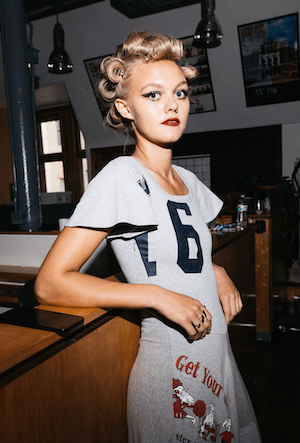
A dress pieced together from recycled gray T-shirts earned a spotlight moment at designer Gabe Gordon’s New York Fashion Week show this month, shining a spotlight on the work – and mission – of Cincinnati’s Sew Valley.
The women-owned nonprofit, based in the city’s West End, is known locally as a sustainability-focused garment factory, sample room and incubator for apparel entrepreneurs. But in Manhattan on Sept. 14, its craftsmanship was on full display in Gordon’s “Autoerotic” collection, a show critics described as one of his most ambitious yet.
Gordon, whose eponymous label is worn by cultural icons including Kim Kardashian and Dua Lipa, rose to prominence in 2021 with his asymmetrical Vortex cardigans. Since then, he and his husband, costume designer Timothy Gibbons, have steadily expanded their vision. In recent collections, they have fused knitwear, tailoring, and textile expertise into pieces that balance a thoughtful exploration of identity with a push for great sustainability practices in fashion design.
Sew Valley, founded in 2017, focuses on helping apparel entrepreneurs and brands manufacture local, ethically sourced garments and materials.
For this collaboration with Sew Valley, that mission took center stage. The collection aimed to put at center stage the partners’ shared commitment to sustainability, blending ethical manufacturing practices with innovative design.
“It was a true pleasure to collaborate with a designer who not only thinks deeply about sustainability and upcycling, but also demonstrates how second hand materials can be repurposed into well-constructed, technically refined garments,” said Sew Valley’s pre-production manager, Evan Neal, who spearheaded the project.
“Working with someone in NYC and seeing the end result showcased so prominently was incredibly rewarding.”
How the collaboration came together
The partnership came together through And Such, a New York-based PR and events firm led by Cincinnati native Kat Cooper. She first worked with Sew Valley earlier this year on another project and came away impressed with the team’s capabilities.
When Gordon and Gibbons needed additional support to bring their Spring/Summer 2026 collection to life, she connected them directly with Sew Valley co-founder and CEO Shailah Maynard and her team.
“Sew Valley shares a similar zero-waste, sustainable ethos to the brand,” Gordon said, “and it was a perfect alignment working with them to recycle T-shirts into new fabrics and garments.”
From there, Gordon’s team shipped thrifted gray T-shirts to Cincinnati. At Sew Valley’s nearly 5,000-square-foot facility – a space outfitted with more than 30 industrial sewing machines, four pressing stations and two large cutting tables – staff deconstructed the shirts, cut them into patterns and reassembled them as new fabric.
Over about 20 hours, Sew Valley’s team transformed the material into both a finished T-shirt dress, which appeared as Look 21 on the runway, and rolls of fresh yardage. That fabric later became several other pieces in the collection, including a button-down shirt, a pair of shorts and corseted jackets and tops.
“We had such a wonderful time collaborating with Sew Valley,” Gordon said.


The “Autoerotic” collection took center stage at DCTV in Manhattan. The inspiration, according to Gordon, was a combination of Madonna’s “Erotica” album (1992) and David Cronenberg’s 1996 film “Crash.” Gordon and Gibbons described it as a meditation on collisions – between sex and queerness, love and death, violence and vulnerability.
The couple invited guests into what they called “the scene of the crash,” presenting their most expansive work yet. Through explorations in knitwear and ready-to-wear, they staged a spectacle that examined American masculinity as performance, destruction and reinvention.
Fashion critics took note. José Criales-Unzueta praised the designers’ ability to embrace their strongest instincts.
“They were at their best this season when they embraced that part of themselves wholly,” he wrote for Vogue. “They make a fantastic knit concoction, be that a stripey, chunky knit or a swingy skirt or roomy dress made of patchworked gray jersey.”
Highlighting the work behind the ‘seams’
For Sew Valley, the collaboration offered an international stage for a mission rooted firmly at home. Founded to support local apparel entrepreneurs, the nonprofit helps designers produce garments efficiently, ethically, and sustainably while fostering long-term job stability in the sewn trades.
Its involvement in New York Fashion Week underscored how those values resonate beyond Cincinnati. But for Maynard, the experience was also about visibility – not just for the garments, but for the people who make them.


Maynard described it as “rare” to see designers at New York Fashion Week publicly recognize those who actually make their pieces. This gesture, though maybe small, is “truly significant, and it has the potential to create a lasting positive shift in our industry.”
“This project was not only a fun and rewarding experience for our team, but it was also incredibly refreshing to collaborate with designers who openly acknowledge the people behind the garments,” she added.
Discover more from Movers & Makers
Subscribe to get the latest posts sent to your email.