
“To tell you the honest truth, I’m a very simple man,” said Cristian Mӑcelaru. It’s been nearly two years since the Cincinnati Symphony Orchestra announced that he would be its next music director. But it has been just three months since he made his debut in his new position. Cristi, as nearly everyone calls him, is still something of a newcomer.

So sometimes it feels like he is still trying to introduce himself to the community. He wants us to know who he is. He talks about his family, his wife Cheryl – a bassoonist – and their two children: 15-year-old Beni, a percussionist, and 12-year-old Maria, a violinist. He tells of spending the holidays in Paris, conducting his other orchestra, the Orchestre National de France, and traveling into the Alsace region to visit festive Christmas markets.
And, of course, he talks about music. He speaks reverentially about his new orchestra and nearly every piece of music they work on together.
“This job is turning out to be so much more than what I hoped,” he said. “The musicians are accomplished, of course. That is a given. But they bring such deep respect to me and to my style of work. When I ask them to do something, their answer is ‘how high can I jump.’ They are so generous to me. It’s a privilege to be treated this way. It speaks to the character and the culture of the orchestra and the entire organization.”
When he started talking about the orchestra’s “American Voices” concerts on Jan. 16 and 17, something much more profound crept into the conversation.
Some of it, perhaps, is that the program includes work by a close friend of his, Wynton Marsalis. Or possibly that the performances feature CSO-commissioned poetry by Rita Dove, the former poet laureate of the United States and a graduate of Miami University.

But his connection to these performances clearly runs much deeper. “American Voices” honors the legacy of Dr. Martin Luther King Jr. and recalls many events of the modern Civil Rights movement. You might think that piece of American history would be remote to Mӑcelaru: He was born 5,000 miles away in Timișoara, Romania in 1980, a dozen years after Dr. King’s assassination. But when he speaks of those long-ago events, it has a very present-tense feeling to it.
“I grew up in Communist Romania until I was 17,” said Mӑcelaru. “I was one of those people looking at America as the beacon of freedom on the hill.”
‘We all need each other’
That became especially poignant for him during the 1989 revolution that overthrew Romanian Communist Party General Secretary Nicolae Ceaușescu and led to executions of him and his wife, Elena.
“So when I came to America, I came searching for that freedom I had heard so much about. And the people I discovered in America were exactly like that. They understood that we all need each other, that a community is reliant on each other. Overall, every person I met in America was that kind of person. I can’t imagine being in a better place than Cincinnati.”
He became an American citizen in 2019.
Mӑcelaru has what he regards as a special connection with Marsalis. “To me, Wynton is more than just a friend,” he said. “The reason I present his work is not just because of our friendship. He represents the style and genre of music and addresses fundamentals that represents our history as Americans.”
The program features three sections from Marsalis’ “Blues Symphony,” which Mӑcelaru recorded with the Philadelphia Orchestra in 2021,
“The idea of the piece is to tell the story of America through the blues,” Mӑcelaru said. “He went all the way back to the Declaration of Independence – the work includes fife and drums – and progresses through the past 250 years up to the struggle in the digital world. It’s absolutely genius. Wynton is not just a brilliant musician, but he is also a deep thinker, a philosopher. When I grow up, I want to be just like him.”
The orchestra will also perform Samuel Barber’s “Adagio for Strings,” but with a bit of a twist. Folded into the music is Dove’s poetry. If that sounds a bit cheeky to build words into Barber’s contemplative work, Mӑcelaru is quick to point out that it was done with the permission of the Barber estate.
“I wanted to find a composition of profound reflection,” he said. “I kept coming back to Barber. It’s one of those pieces that you hear the first note and the chord that follows it and everything seems to stop and reflect.”
And why Rita Dove? For that matter, why the addition of poetry?
“I think Rita Dove’s poetry matches the intensity of the music. And, in her formative years, she played the cello. So she has an understanding of music that some other poets might not have. My only regret is that I couldn’t convince her to read the poetry herself. (Bass Morris Robinson will do the honors in her place.) My hope is that it will provide a beautiful moment of to reflect on our past and our identity and perhaps a moment to recommit to the values that we all share.”
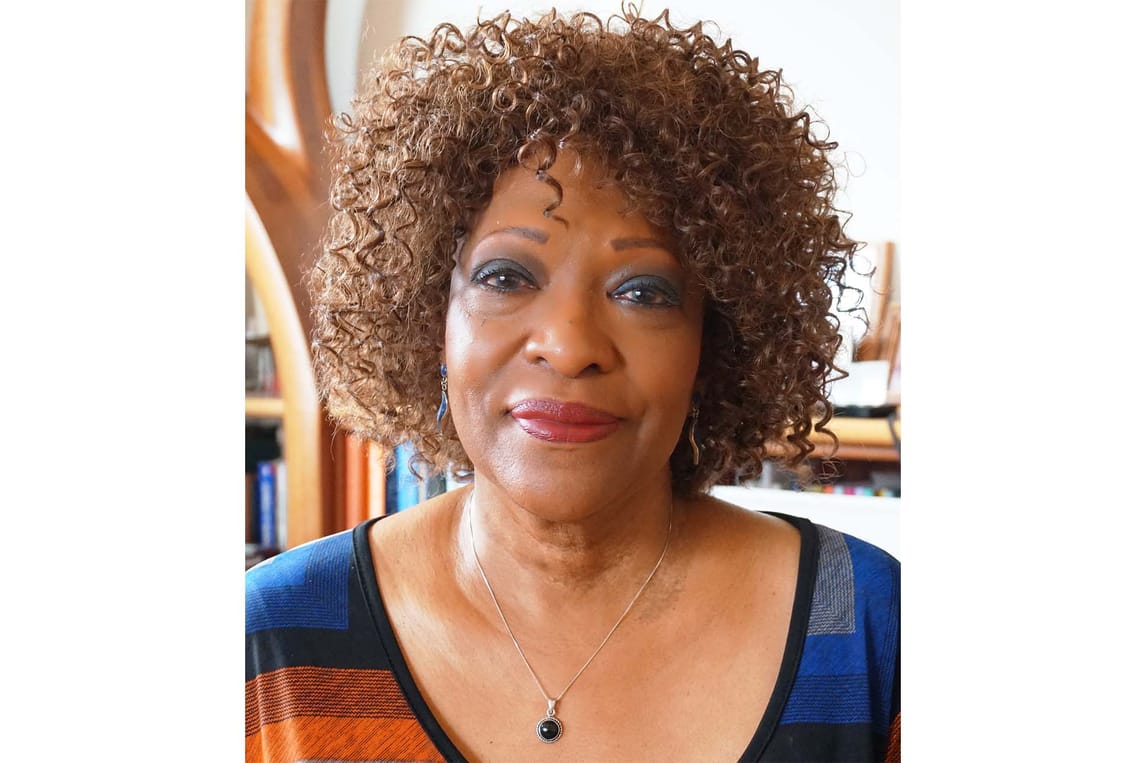

(photo by Tina Gutierrez)
“American Voices” also includes the CSO premieres of four movements from Margaret Bonds’ “Montgomery Variations,” a work composed soon after the 1963 terrorist firebombing of Birmingham, Alabama’s 16th Street Baptist Church, which killed four young girls.
“I think her music will be a revelation to our audiences,” said Mӑcelaru. “Because there was no publisher there to promote her music, she was almost forgotten. Her white male counterparts were always pushed by agents or publishers. But in the last 10 years or so, much of her music has been published and recorded, and finally we are having a chance to introduce her to our audiences.”
‘Alive’ with references to AI
Our conversation is nearing an end. But Mӑcelaru didn’t want to hang up before he mentioned this coming weekend’s performances on Jan. 10 and 11.
In some regards, it is a more traditional CSO concert, with Brahms’ “Academic Festival Overture” and Beethoven’s Piano Concerto No. 2, featuring the return of dazzling pianist Daniil Trifonov.
But Mӑcelaru wants to be sure that we know about the third piece on the program, the U.S. premiere of the completion of a CSO co-commission – Daníel Bjarnason’s Trilogy for Orchestra, including the new, final movement, “I Want to Be Alive.”

“This is the first time the entire work will be heard in the United States,” said Mӑcelaru. “This was commissioned before I came to Cincinnati, so I am inheriting this piece. But it is truly a fantastic piece of music, a massive and important statement. There are references to AI and Bjarnason’s interpretation of what has happened to the world. He says it is like opening Pandora’s Box. But he also reminds us that many things that came out of Pandora’s Box were positive.”
For the record, Bjarnason did not employ AI to compose the final movement, but he used all manner of other sound-generation software in its creation.
“The piece is so colorful,” said Mӑcelaru. “And the orchestra sounds so amazing playing it. Composers have always been on the front of edge of innovation, finding new ways to make the statements that want to make.
“I know that sometimes people are a little frightened of new music. But this piece is really remarkably beautiful. There are moments of serene beauty and others that are rhythmically charged. It has excitement for the future, but there are also colors of foreboding.”
He paused for a moment, trying to find a way to conclude our conversation.
“You know, music is such a gift to us. Yes, I know that there are difficulties on both sides of the Atlantic. But I do love the idea that, here in Cincinnati, we are building a community, not just a concert and an orchestra. I have lived in America for 23 years now. This is something that I find noble and beautiful. People understand that unity and community are causes that are worth investing in. They understand that the best doctor for your emotions is the arts. And here in Cincinnati we have such a great opportunity to make a difference in people’s lives. We can do it together.”
CSO at Music Hall. Cristian Mǎcelaru, conductor
- Jan. 10, 7:30 p.m. & Jan. 11. 2 p.m. Music of Brahms, Beethoven and Bjarnason. Daniil Trifonov, piano.
- Jan. 16, 11 a.m. & Jan. 17, 7:30 p.m. Music of Margaret Bonds, Samuel Barber and Wynton Marsalis. Poetry by Rita Dove. Morris Robinson, narrator.
Discover more from Movers & Makers
Subscribe to get the latest posts sent to your email.